Fix guide
Does a VPN lower your ping? Usually not — and here is when it can
Search results promise VPNs that reduce ping. Physics says a VPN adds a detour. Both can be true at once, which is why the answer is "usually worse, occasionally better", with a way to tell which case you are in.
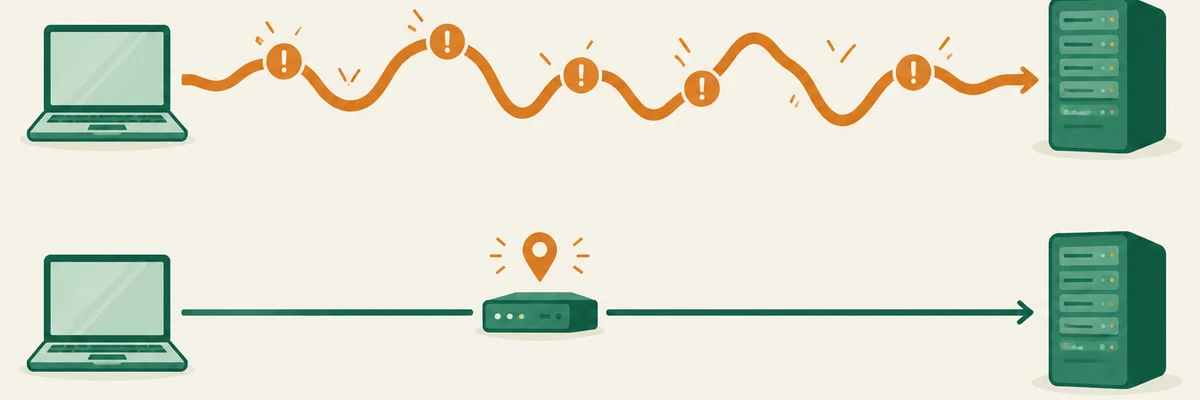
Why it usually adds latency
Your traffic goes to the VPN server first, then onward to the game. If the VPN server is not on a better path than your provider would have taken, you have simply added a leg to the journey and often an unnecessary encryption step.
Not sure where your problem is? Run the free test first — it takes about 45 seconds and tells you which of the fixes on this page actually apply to you.
Run the connection checkThe narrow case where it helps
If your provider routes your traffic through a badly peered or congested path, and the VPN provider has a good path from a nearby city, the detour can be shorter than the bad direct route. This is not magic — it is the same mechanism a route optimiser uses, with a different set of servers.
How to test it properly
- Measure without the VPN first, several times, at the hours you actually play.
- Measure with it on, same region, same hours.
- Compare the worst samples and jitter, not just the average.
- If a game has a region selector, test both with the VPN off — a nearby region often beats a clever route.
The honest conclusion
If your problem is local instability, a VPN makes it worse. If it is distance, a VPN cannot fix it. If it is one badly routed path, a VPN or a route optimiser is a legitimate thing to test — on a trial, with measurements written down, not with a feeling on one good night.